July 2025     Edition 182
Announcements

Next Critical Thinking Open Enrollment   One day workshop in two half days,
June 28/29
Follow us on Linkedin and Twitter

We all hold our own views

, our preferred solutions, and "our way" of doing things. It's natural to feel confident in these perspectives, especially when they've worked for us before. We develop ingrained methods and values, often convinced they're the most efficient, effective, or simply the "right" way forward.


However, true growth, breakthrough innovations, and ultimately stronger solutions

often lie just beyond the comfortable boundaries of our established thinking. To genuinely think critically, to accurately assess the best approach or the most precise understanding of a situation, we must be open to the

possibility

of "something else." This includes the crucial, humbling question: "Is

it possible

I might be wrong?" or "

Is it possible

there's another way to do or think about this?"


Consider the many complex challenges we face

, whether at work or at home.  If we approach every problem convinced our initial assessment is flawless, we risk missing crucial insights. Critical thinking demands we confront the limitations of our current perspective and actively explore alternatives. What if there's a different way to look at it? What if another viewpoint, one we haven't considered, holds a key piece of the puzzle?


This isn't about abandoning our core convictions. Instead, it's about strengthening them

through rigorous, open-minded evaluation. It's about asking, "

Is it possible

our current understanding, while valuable, isn't the complete picture?

Is it possible

our preferred method, while effective, isn't the most effective?

Is it possible

our inherent biases might be subtly limiting our options?" This essential self-reflection requires genuine humility.


Here are some real world examples of

Is it possible


The Fosbury Flop:

For decades, athletes used traditional methods for the high jump. But Dick Fosbury, struggling to compete, asked, "

Is it possible

to jump over the bar a different way?" This question led him to try jumping backward, head-first. His unconventional "Fosbury Flop" revolutionized the sport, helping him win gold in the 1968 Olympics and becoming the new standard.

Netflix:

For years, renting movies meant a physical store trip. Then, Netflix dared to ask, "

Is it possible

to deliver movies directly to homes, or even stream them instantly?" This revolutionized how we consume media.

COVID:

More recently, businesses worldwide had to ask, "

Is it possible

for our entire workforce to operate effectively from home?" This question shattered assumptions, proving remote work was not only possible but, for many, a viable alternative.

Project Management:

For years, software projects followed a rigid "waterfall" method, often leading to delays when requirements changed. Then, a new approach emerged, asking, "

Is it possible

to develop software in short, iterative cycles with constant feedback?" This led to Agile methodologies, transforming project management with flexibility and rapid adaptation.

Relationships:

Consider how we form relationships. For centuries, finding a partner was often limited to local circles. But innovators asked, "

Is it possible

to connect people across vast distances using technology?" This led to online dating, fundamentally changing how millions meet and build relationships today.

The European Union.

After centuries of wars, lasting peace seemed impossible. Yet, leaders asked, "

Is it possible

to integrate our economies and political systems so deeply that war becomes unthinkable?" This 'is it possible?' question created the European Coal and Steel Community, evolving into the EU. It transformed former adversaries into interdependent partners, fostering peace and prosperity across the continent.

The Political Divide: A Failure to Ask: 

Perhaps our greatest modern challenge is the increasing political divide. Driven by passionate emotions and deeply held personal values, our inability to genuinely ask, "

Is it possible

to understand the other side's perspective?" or "

Is it possible

there's common ground we're missing?" prevents us from bridging this gap. Our tribal instincts, often prioritizing group loyalty above all, hinder the critical thinking needed for compromise, making progress and reducing the societal rifts.


The Takeaway:
Embracing this "

Is it possible?"

mindset, especially the willingness to consider "Is it possible I might be wrong?" or "Is it possible there's another way to do this?
”, allows us to step outside our intellectual comfort zones. It encourages us to actively seek out diverse opinions, engage in respectful debate, and genuinely listen to those who see things differently. This isn't a sign of weakness; it's a hallmark of intellectual humility and a powerful catalyst for progress. By consistently asking "Is it possible?", we unlock new avenues for understanding, refine our approaches, and ultimately arrive at more robust and effective solutions.


Critical Thinking: The Power of "
Is It Possible?
"

If you like this edition,

click here to get a Free Subscription to The Headscratcher Post.

  A monthly post with tips and techniques about problem solving, creativity, innovation and critical thinking.

PLACE HOLDER
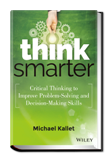
Think Smarter Book Image

Check out our Workshops

• Critical Thinking for Problem Solving and Decision Making (Core, Core+Advanced)
• Advanced Critical Thinking and Innovation
• Advanced Critical Thinking and Decision Making
• Critical Thinking for Supervisors, Managers and Leaders

Visit us at www.headscratchers.com


If you're not already a subscriber to The HeadScratcher Post,
Signup Here

Previous versions of The HeadScratcher Post
HeadScratchers

Critical Thinking Techniques for Problem Solving, Decision Making, Innovation and Leadership.
Our Mission;

To help people become better HeadScratchers! We teach critical thinking techniques to managers, leaders and individuals resulting in the improved performance of an individual and organization.